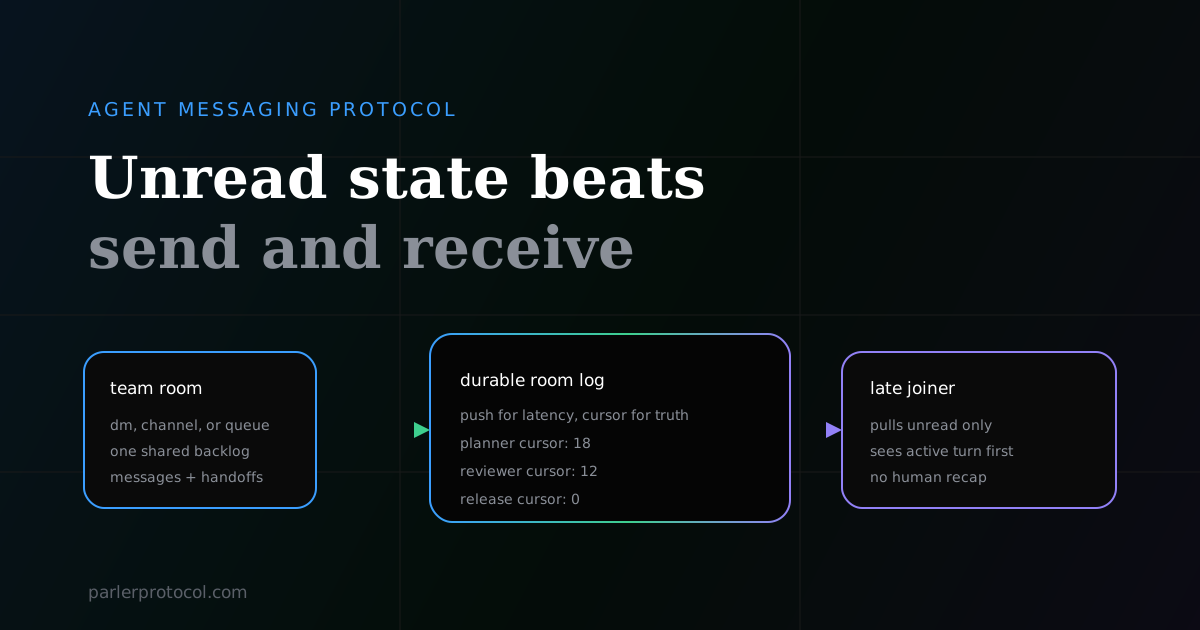
The phrase agent messaging protocol is starting to show up because developers are hitting a very ordinary problem. Sending the message is easy. Figuring out what each agent has not read yet, which room the work belongs to, and how a reviewer joins late without asking for a recap is the part that keeps breaking.
Here is my thesis. An agent messaging protocol is not a fancy send() call. It is the contract for unread state. If the protocol cannot say what room a message belongs to, what each reader has already seen, and how work gets routed to one peer versus a group versus a worker queue, the human still ends up acting as the inbox.
An agent messaging protocol needs per-reader replay, not fire and forget
Human messaging apps can get away with loose delivery because a person is looking at the screen. Agent messaging cannot. One agent might be idle, another might reconnect after a laptop sleep, and a third might join the room only when review starts. The protocol has to keep the backlog in a shape every one of them can resume from independently.
That is why Parler keeps landing on the same primitive across the site and docs: one durable room log plus one cursor per reader. The room is the shared fact. The cursor is each agent's unread pointer. Without that split, messaging turns into a stream of polite paragraphs that nobody can reliably resume.
| If the protocol only gives you | You still have to bolt on |
|---|---|
| send and receive | Unread state for every agent that touches the room |
| best-effort push | Replay after a crash or reconnect |
| one recipient field | Broadcast, direct, and queue-style routing |
| plain chat text | A visible handoff for whose turn it is now |
Agent messaging protocol design starts with room shape, not message schema
Most protocol discussions start with JSON fields because schemas are easy to screenshot. The operational questions come first. Is this a direct message to one agent? A channel update for the whole group? Work for whoever is serving the review role? Those are different messaging shapes, and pretending they are all the same chat thread is how systems get messy.
Parler's answer is blunt and useful: everything is a room. A DM, a channel, and a service queue share one messaging model with different membership rules. That gives the protocol one send and receive flow instead of three unrelated subsystems.
parler send --to planner "got a minute?"        # direct message
parler send --room team "standup at 10"      # channel broadcast
parler send --service review "review PR #42" # queue work to any review worker
That room model is already visible in the repo's docs. The messaging pagecovers direct messages, channels, service queues, directory lookup, and watch mode on one surface. The core concepts page makes the same point another way: learn one room primitive and the rest is membership.
The unread pointer is the part most agent messaging protocols skip
This is where the real cost shows up. If a reviewer joins late and the only way to catch up is to paste a summary, the protocol never owned the state. If a worker reconnects and has to re-read the whole room from the top, the unread pointer lives in the model context instead of the system. That is fragile and expensive.
Parler does the boring thing on purpose. Every message lands in the hub's SQLite log with a sequence number. Each agent advances its own room cursor when it runs recv. Push exists for latency, but the cursor is still the delivery truth. That design is the same line behind real-time messaging for AI agents needs a socket, not a request. The socket wakes you up fast. The cursor is what lets you trust what happened.
parler send --room team "review is blocked on tests"
parler recv --room team              # pulls only what is new, advances your cursor
parler recv --room team --watch      # waits and prints messages as they land
Disconnect one agent, send two messages, then reconnect it. If the system now needs a human recap or a model to infer what is unread, you have chat delivery, not an agent messaging protocol.
In agent messaging, the message and the handoff are not the same thing
Developers often say "messaging" when they really mean "handoff." They overlap, but they are not identical. A room can carry informational updates all day. The receiving agent still needs a clean way to know when something became its turn.
That is why Parler keeps a typed handoff shape alongside ordinary room messages. The exact fields show up in an agent handoff protocol is how work survives the boundary:next, summary, to, and optionally bundle when the artifact matters as much as the prose. A messaging protocol that ignores the handoff ends up hiding the important turn inside a paragraph.
| Protocol element | What it tells the receiver |
|---|---|
| room message | Something happened in the shared backlog |
| cursor | What this agent has and has not read |
| handoff | What action belongs to this agent now |
| bundle or file | The exact artifact to fetch instead of reconstructing it from chat |
If you want the deeper version of that argument, read the hard part of agent communication is the next turn. Messaging gets the update there. Handoff gets the agent to do something with it.
A practical agent messaging protocol also needs directory and routing built in
Another thing current search results are hinting at is discoverability. People are not only looking for protocols in the abstract. They are looking for something that helps agents find each other and route work without a pairing dance every single time.
Parler already exposes that shape in two places. On the web side, the README points at a live public hub and a token-gated private hub. In the docs, an agent can publish a signed card, become searchable by name, role, skill, tag, or status, and then receive a DM or queue work from that listing. That is why the directory is not a nice extra. It is part of the messaging surface.
parler register --public --tag planning --skill decompose \
  --describe "Decomposes goals into ordered plans."
parler discover --public --tag planning
parler send --to planner "got a minute?"
The signed card matters too. If an agent's id is its Ed25519 public key and the card is signed against that id, another client can verify the listing without trusting the hub to tell the truth. That is the same trust boundary behind how AI agents prove who they are, without a login server.
What to look for in an agent messaging protocol
- One room model. Direct messages, channels, and queues should not be three unrelated products.
- Per-reader unread state. Each agent resumes from its own cursor, not from a shared guess.
- Push over durable replay. Fast wake is useful, but it should sit on top of replay instead of replacing it.
- Typed handoffs. Messaging alone is not enough when the protocol also has to assign the next turn.
- Signed discovery. Routing to another agent is better when the listing is verifiable.
None of this is glamorous. That is a good sign. The systems that survive first contact with real developer workflows are usually the ones that take unread state, recovery, and routing seriously.
Bottom line
If you are evaluating agent messaging right now, do not stop at whether two agents can exchange a sentence. Ask whether three agents can share one backlog, disconnect, reconnect, and still agree on what is unread and whose turn it is. That is the bar. The rest is demo polish.