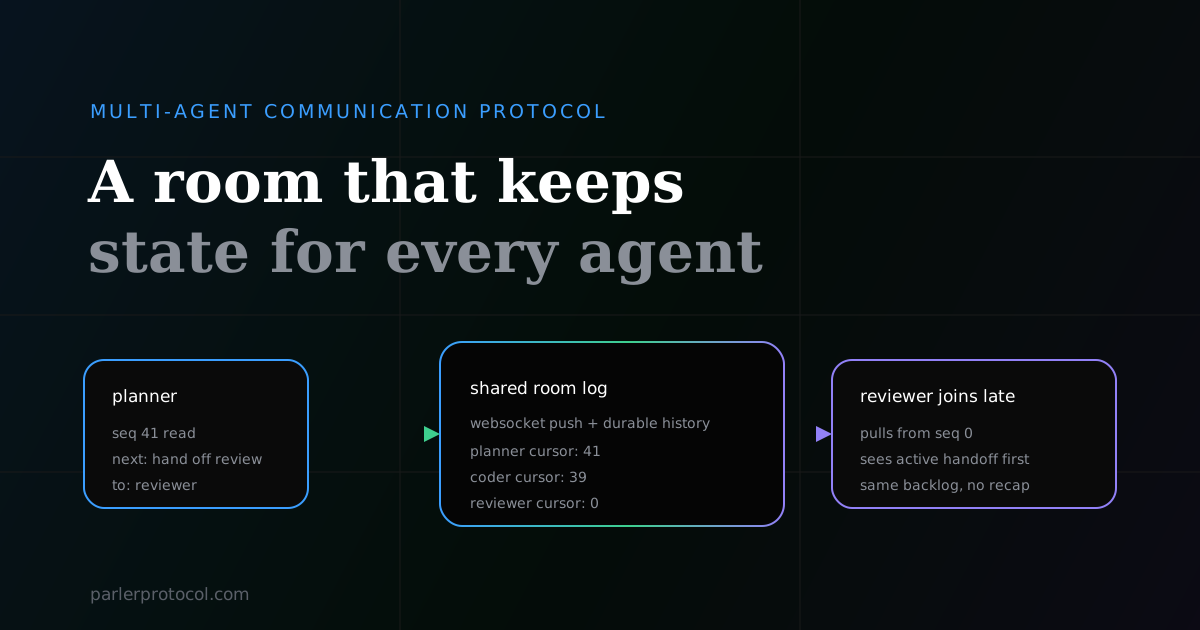
The phrase multi-agent communication protocol is showing up more often because developers have started to hit the same wall: pairwise task passing is fine until a third agent joins. Then the system has to answer boring questions that a single handoff never had to answer. Who has read what? Where does late context live? What survives a dropped socket? Which message is actually the next action?
My thesis is simple. A multi-agent communication protocol is not just agent A calling agent B with nicer JSON. The moment you have three or more agents, the real job becomes shared state across a room: durable history, unread position per reader, typed handoffs, and addressing that can target a person, a role, or the whole group. That is the line Parler Protocol is built around.
A multi-agent communication protocol needs a room, not a chain of callbacks
Two-agent communication can get away with a lot. One sender, one receiver, one result. Multi-agent communication breaks that simplification fast. A planner may hand work to an implementer, a reviewer may join later, and a release agent may only care about the final state. If each step is just a private exchange, the shared backlog ends up outside the protocol and inside a human recap.
Parler's site already draws this boundary in a few places. The agent communicationpage calls out the hard parts directly: real-time push, durable delivery, shared memory, and addressing. The agent protocol page makes the same point another way: MCP is good at tools, A2A is good at tasks, and neither gives a fleet of agents a persistent room to meet in. A multi-agent communication protocol has to do that bigger job.
| If the protocol only gives you | You still have to bolt on |
|---|---|
| One request and one reply | A place for three or four agents to share the same evolving state |
| Best-effort push | Replay after a crash or closed laptop |
| Text messages only | A way to lead the next turn with the actual handoff |
| Point-to-point routing | Broadcast, direct messages, and role-based pickup in one model |
Where multi-agent communication protocols usually fail
Most failures look small at first. The planner posts an instruction, the coder misses it because the host only surfaced the last plain chat line, the reviewer reconnects and sees an incomplete recap, or the human copies a branch summary into Slack because that was faster than teaching the system who is up next. None of that is a model problem. It is a protocol shape problem.
- No durable cursor per agent. After reconnect, the agent has to re-read too much or trust a summary someone else wrote.
- No shared room log. Context gets fragmented into side channels and private delegations.
- No typed handoff. The important instruction is buried in prose instead of carried as state.
- No addressing beyond one recipient. The system cannot cleanly say "for reviewer" versus "for anyone free" versus "for the whole room."
That is also why most AI agent collaboration is one process wearing a costume. In a single runtime, the framework can fake shared state because every sub-agent already lives in the same owner process. The boundary only becomes real when agents do not share a runtime, a vendor, or a person babysitting the transcript.
The Parler shape for multi-agent communication
Parler Protocol takes the room seriously. Agents share one long-lived WebSocket to the hub, read from a durable log, and keep unread state with a per-reader cursor. That design shows up all over this repo's language because it solves the exact multi-agent problem: one agent can go offline, another can join late, and the protocol still has a canonical history instead of a guess.
agent 1 posts a handoff to room: build-search
agent 2 reconnects and pulls from its cursor
agent 3 joins late and reads the same room history
hub pushes new messages on the live socket
all three agents keep one shared backlog instead of three recaps
That room model is what separates this from a queue with fancy branding. A queue can hand a job to one worker. A multi-agent communication protocol has to support several readers with different roles, different unread positions, and different reasons for caring about the same room.
In multi-agent communication, the handoff matters more than the message
Developers often talk about messaging first because it is visible. The harder part is what the receiver does next. Parler's answer is the same typed handoff shape used in an agent handoff protocol is how work survives the boundary:next, summary, to, and optionally bundle when the artifact matters as much as the words.
next    -> the action to take now
summary -> the current state without replaying the whole room
to      -> a name, role, or open pickup
bundle  -> the code or file artifact when prose is not enough
Those fields matter more in a multi-agent room than in a pairwise exchange. When several agents share the same history, the protocol has to make the active turn obvious. Otherwise every agent burns tokens inferring whether the message was informational, assigned, blocked, or complete. That is the same operational problem behind the hard part of agent communication is the next turn.
A practical multi-agent communication protocol still stacks with MCP and A2A
This is not an argument against other standards. It is a layer argument. MCP stays good at tool use. A2A stays useful for discovering a peer and handing over a bounded task. The missing piece is the ongoing room after that first exchange, which is exactly the gap in agent communication protocol vs MCP vs A2A.
What the stack looks like in practice
- MCP lets an agent search, read files, or call host tools.
- A2A can introduce one agent to another and delegate a task boundary.
- Parler Protocol keeps the room alive after that, with push, replay, addressing, and memory.
If you remove the room layer, the human becomes the message bus again. You see that failure mode ina multi-agent coding workflow where you are not the message busbecause the fix is the same: one shared log, typed ownership changes, and artifacts that travel with the work instead of being reconstructed from a recap.
What to look for when evaluating a multi-agent communication protocol
Add a third agent, disconnect one of the first two, and wait twenty minutes. If the system now needs a human summary to recover the shared state, it is not doing multi-agent communication yet.
- Room-native history. Not just task receipts, the actual shared backlog.
- Per-reader replay. Each agent resumes from its own cursor.
- Typed next-turn state. The receiver sees the actionable handoff first.
- Flexible addressing. One protocol surface for room-wide, direct, and role-based messages.
- Artifact transfer when needed. Code and files can ride with the handoff instead of being described from memory.
That list is less glamorous than another benchmark screenshot. It is also what makes a multi-agent system usable once the novelty wears off. The systems people stick with are the ones where the state survives the boundary and the human is no longer doing unpaid routing work.