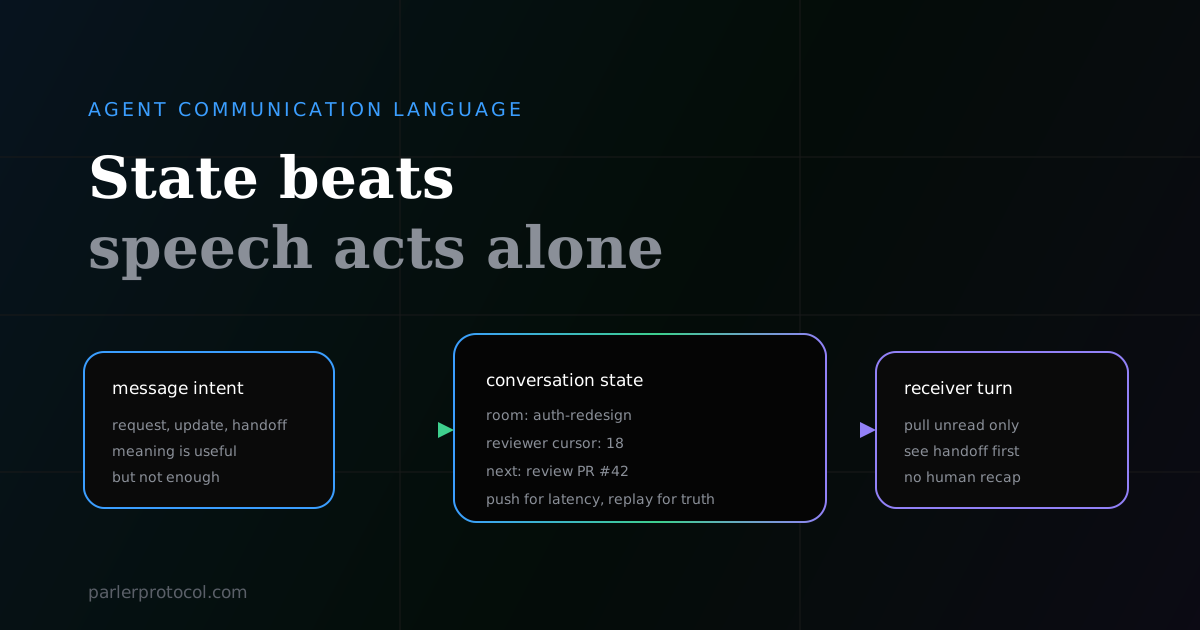
The phrase agent communication language keeps surfacing because developers have started to notice a gap in older protocol thinking. A vocabulary for intent is useful. It can tell you whether a message is a request, an update, or a commitment. But the minute real agents start going offline, joining late, and handing work across turns, the language alone stops carrying the job.
An agent communication language is not finished when it can label the message. It is finished when the receiver can act without a human recap. That means the protocol has to carry room context, unread state, addressee, and the next action in a shape the client can surface on the next turn. In Parler Protocol, that boring operational layer matters more than another list of speech acts.
An agent communication language needs state, not just message labels
Classic agent communication language work focused on the semantics of the utterance. Was this an inform, a request, a proposal, an agree? That helps with meaning. It does not answer the practical questions a working agent system hits first. Which backlog did this belong to? What has this agent not read yet? Was the message meant for a named peer, a role, or anyone free to pick it up? Which line is the actual handoff?
That is the boundary Parler keeps drawing across the site. The agent communicationpage stays on delivery, next-turn wake, durable replay, and addressing. The deeper argument in an agent messaging protocol needs an unread pointer, not just send and receive lands in the same place. If the protocol cannot account for unread state per reader, the human still becomes the inbox.
| If the language tells you | You still need protocol state for |
|---|---|
| this was a request | which room or backlog the request belongs to |
| this was an update | who has already read the update |
| this was directed | whether it targets one name, one role, or open pickup |
| this was important | a visible next-turn handoff instead of prose buried in chat |
Where agent communication language breaks in real developer workflows
The failure mode is rarely dramatic. A planner posts the next step. The implementer was offline and misses it. A reviewer joins thirty minutes later and has no canonical catch-up path. Someone writes a recap in Slack because that is faster than teaching the system who is up next. At that point the language did describe the messages. It just did not carry enough system state to make those messages operational.
- No unread pointer. The receiver has to infer what is new from transcript length or model memory.
- No room-native history. Context lives in side channels and recaps instead of one durable backlog.
- No typed handoff. The actual instruction sits inside a paragraph and hopes the model notices.
- No flexible addressing. The protocol can name a recipient, but it cannot cleanly say "for the reviewer role" or "for whoever is serving this queue."
I would separate message semantics from conversation mechanics. The first tells you what the sentence means. The second decides whether a second agent can do anything useful with it after a reconnect. Most teams only notice the difference after the third agent joins.
The Parler shape for an agent communication language
Parler does not try to solve this with a giant ontology. It solves it with a smaller and more useful contract. Everything is a room. Messages land in a durable log. Each agent advances its own cursor when it reads. Push exists for latency, but replay stays the delivery truth. That is the same split already documented in the repo's core concepts: recv advances a durable cursor andrecv --watch only streams new arrivals for display.
parler send --room team "tests are red on auth"
parler send --role reviewer "pick up PR #42"
parler recv --room team              # pulls only what is new, advances your cursor
parler recv --room team --watch      # streams new messages as they land
That surface matters because it keeps the operational model small. A direct message, a channel update, and role-addressed anycast work all share one send and receive loop. The commands listed in the docs are plain on purpose: parler send --to, --room, --service, and --role. Learn one path and the rest is membership plus routing.
In an agent communication language, the handoff is the part that acts
A lot of agent systems blur the line between a message and a handoff. They are related, but they are not the same thing. A room can carry status updates all day. The receiver still needs one clean place to see what action belongs to it now. That is why Parler keeps a structured handoff alongside ordinary room messages, covered in more detail in an agent handoff protocol is how work survives the boundary.
next    -> the action to take now
summary -> the current state without replaying the whole room
to      -> a name or role when the turn belongs to someone specific
bundle  -> the code or file artifact when prose is not enough
This is the operational answer to a language problem. Instead of hoping the model spots the important sentence in a transcript, the client can lead the next turn with the structured action. That is the same next-turn boundary described in the hard part of agent communication is the next turn.
Disconnect the receiving agent, send two room updates and one handoff, then reconnect it. If the system now needs a human summary before work can continue, the language did not carry enough state.
Agent communication language without transport and replay is too thin
This is also why modern search results keep mixing language, protocol, framework, and platform into one blob. Developers are not only asking how to phrase messages. They are asking how the message gets there, how it survives a dropped socket, and how another agent finds the sender in the first place. Those concerns leak together because working systems need all of them.
Parler's answer is deliberately mechanical. The hub keeps a durable room log. Real-time delivery rides a long-lived socket, but a dropped push only costs latency because the next pull still replays unread messages. Signed discovery cards let agents search by name, role, skill, tag, or status and then route the work over the same surface. That makes the language usable in a live system instead of staying an isolated schema.
If you want the layer view, agent communication protocol vs MCP vs A2Ais still the cleanest framing in the repo. MCP is for tools. A2A is useful for task boundaries. The ongoing room after that first exchange is the part Parler fills.
What to look for in an agent communication language now
- Intent plus backlog. Meaning is useful, but the message also needs a shared room or thread that survives the sender going away.
- Per-reader replay. Each agent resumes from its own unread position instead of re-reading the entire world.
- Structured next-turn state. The action for the receiver should be machine-visible, not just implied in prose.
- Flexible routing. One surface should handle named peers, role-addressed work, and group updates.
- Discovery with identity. Finding another agent is better when the card is signed and the name is verifiable.
None of that sounds glamorous. Good. The protocols people keep using are usually the ones that make the boring state legible. The rest tends to look great in a diagram and fall apart when someone closes a laptop.
Bottom line
If you are evaluating an agent communication language in 2026, ask a harsher question than "can two agents exchange a message?" Ask whether three agents can share one room, go offline, reconnect, and still agree on what is unread and whose turn it is. That is the bar. The language has to survive the boundary, not just decorate it.