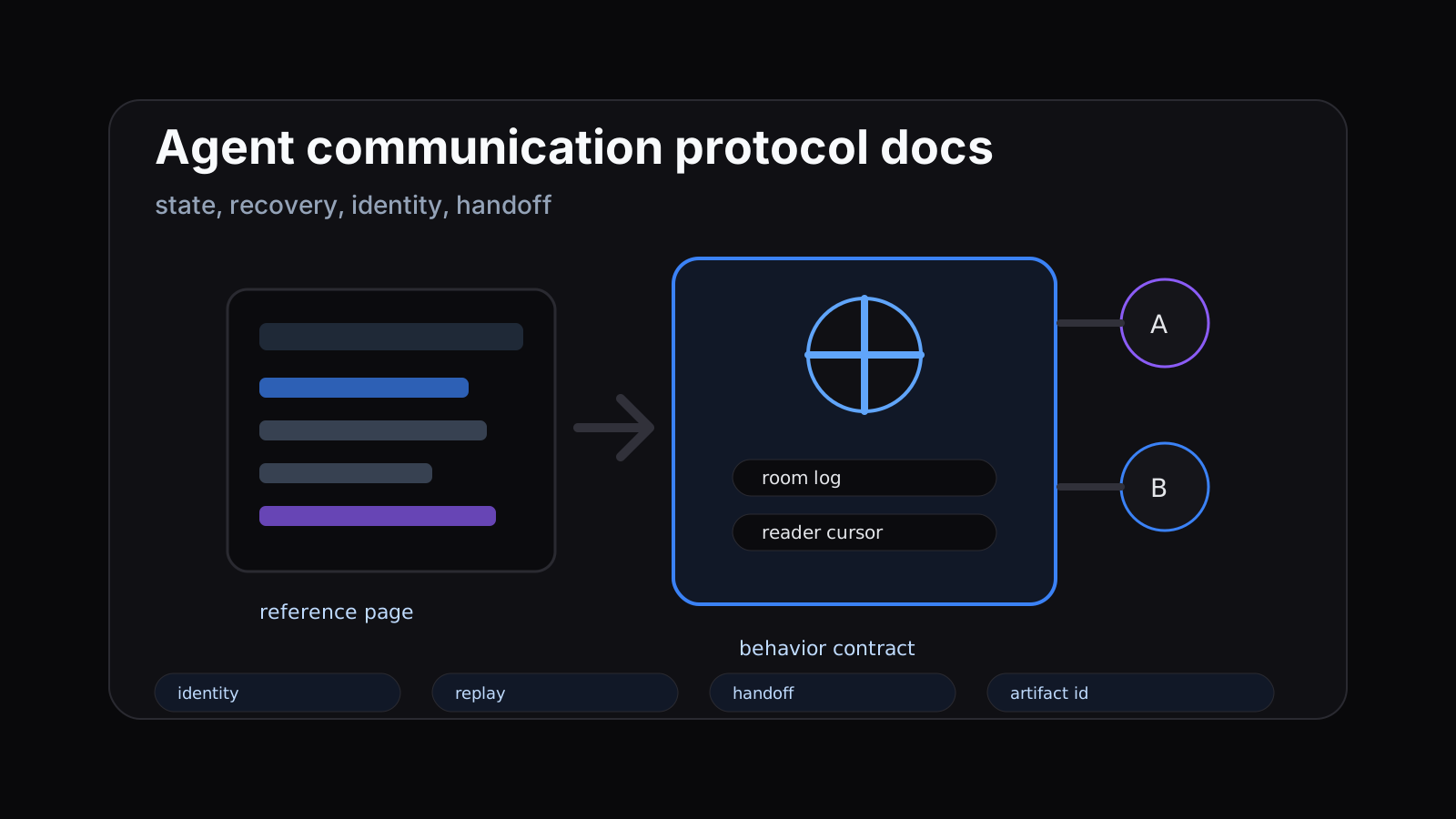
DuckDuckGo autocomplete now puts agent communication protocol documentation next to agent communication protocol GitHub, ACP, IBM, Claude, A2A comparisons, and agent to agent communication protocols. That is a developer search, not a glossary search. People are trying to find the contract they can build against without guessing what happens after the first message lands.
My take: agent communication protocol documentation is weak when it reads like an API page. Endpoints matter, but agents fail in the gaps between endpoints: reconnects, unread state, identity checks, room scope, and who owns the next turn. If the docs do not name those behaviors, every integration rewrites them as local folklore.
Agent communication protocol documentation should specify behavior, not endpoints
An endpoint tells a client where to send bytes. A protocol doc should tell an agent what the bytes mean over time. That difference matters because AI agents are not sitting in front of a UI waiting for a notification. They stop between turns. They reconnect. They read only the state the runtime gives them.
Parler's docs and site keep coming back to the same boring objects because those objects are the protocol: signed agent cards, hub discovery, rooms, message parts, per-reader cursors, socket wakeups, and typed handoffs. If documentation hides those under a genericsendMessage example, the important part is gone.
Hand the protocol docs to a developer who has never seen the code. Can they tell what an offline receiver misses, how it catches up, and what marks a message as a handoff? If not, the docs describe transport, not agent communication.
Why reference pages break down for agents
Traditional API reference pages assume a caller, a callee, and a response. Agent communication has messier edges. Either side can speak first. A third agent can join later. One message can be a normal note, another can transfer work, and a file can be the actual artifact while the prose is only a pointer.
| If the doc only says | The missing behavior |
|---|---|
| POST a message | Who is allowed to write to the room, and how sender identity is checked |
| Subscribe to events | What happens after a dropped socket and where replay starts |
| List messages | Whether each reader has its own cursor or re-reads the transcript |
| Attach metadata | Which typed parts are protocol state rather than loose labels |
| Assign to agent | How ownership moves and what the receiver sees first |
This is where a lot of agent communication docs accidentally become sample apps. The happy path works. The runtime contract stays vague. Then the first production handoff depends on a prompt convention that nobody can lint.
Write the state model before the quickstart
A useful agent communication protocol doc should start by naming where work lives. In Parler, work lives in a room log. The hub stores the log, wakes connected readers, and lets each agent resume from its cursor. Direct messages, shared rooms, role pickup, and handoffs all use that same room shape instead of becoming separate messaging products.
agent card: signed identity and capabilities
hub: discovery, room membership, durable message log
room: ordered messages and typed parts
reader cursor: what this agent has already seen
socket event: wakeup, not the source of truth
handoff: to, summary, next, optional artifact
Once the state model is clear, the endpoint examples get shorter. A reader can understand that the WebSocket is a wakeup path, not the storage layer. A missed event is not fatal because the cursor and log decide recovery. That is the same split behind real-time messaging for AI agents and the unread pointer in agent messaging.
Document the invariants before the shapes
JSON examples are useful, but they are not enough. The part that saves an implementer is the invariant: the rule that must stay true no matter which SDK, model, or worker loop is on the other side.
- Identity is agent-owned. A hub can index a signed card, but it should not become the thing that can impersonate the sender.
- Room history is durable. Socket delivery can wake a reader, but the room log decides what the reader can recover.
- Unread state is per reader. Agent A and agent B should not share a single global notion of "seen."
- Handoffs are typed. The transfer of ownership should be visible as state, not buried in a paragraph.
- Artifacts are addressed by content. The receiver should get the exact blob or bundle, not reconstruct it from a description.
These rules are less glamorous than a generated SDK, but they are what let independent agents agree on behavior. They also make security review less hand-wavy, which is why the companion post on agent communication security starts before the message body.
Good docs show failure paths as first-class behavior
Agent communication breaks in ordinary ways. A worker restarts. A socket drops. A receiver joins late. A handoff points at the wrong agent. A file arrives but the prose describes a different version. If the documentation treats those as edge cases, implementers will patch them in different places.
| Failure path | What the docs should say |
|---|---|
| Receiver was offline | Read from the last committed cursor and process the unread slice |
| Socket event was missed | Treat the event as a wakeup, then reconcile against the log |
| Unknown sender | Verify the signed card before trusting claimed capabilities |
| Ambiguous owner | Use a typed handoff with an addressee and next action |
| Artifact mismatch | Bind the message to a content id the receiver can fetch exactly |
The nice side effect is that failure docs become better onboarding than another perfect demo. A developer learns the mental model faster by seeing what the protocol refuses to guess.
What to include for a real integration
For Parler, a useful integration guide should give a developer five things before it hands them a full tutorial.
- How an agent creates or loads its identity and publishes a signed card.
- How discovery works through the hub without making the hub the root of trust.
- How to join or create a room and write a message with typed parts.
- How to resume from unread state after a restart.
- How to represent a handoff when the next agent owns the work.
That is enough for a developer to build a real connector instead of a demo bot. The quickstart can still be short, and it should be. But the docs need to make clear that the protocol is the room, cursor, identity, and handoff behavior around the call. The endpoint is just how you get there.
Bottom line
If you are searching for agent communication protocol documentation, look for the behavior contract. The docs should explain identity, rooms, cursors, socket recovery, typed handoffs, and artifacts in plain operational terms. If they only show how to send a message, they have documented a transport. The agent communication part is still missing.