Google autocomplete now puts agent communication protocol GitHub inside the same branch as agent communication protocol, ACP, A2A, MCP, IBM, Zed, and Google. GitHub search is noisy too: a live repository search for "agent communication protocol" returns hundreds of projects, while "agent-to-agent communication protocol" and "multi agent communication protocol" both return active protocol repos. That is not a curiosity search. Developers are looking for code they can run and break.
My take: an agent communication protocol GitHub repo should prove the runtime behavior, not only publish a schema. The useful repo shows what happens when the receiver is offline, when a socket drops, when a handoff names the next owner, and when the work is a file instead of a paragraph.
Agent communication protocol GitHub searches are really recovery searches
A developer searching GitHub for an agent communication protocol is usually past the glossary stage. They know agents need to talk. The question is whether the implementation survives the boring parts of real work: reconnects, late joins, unread state, signed identity, and artifacts that cannot be rebuilt from a summary.
That is why a repo with a clean message type and no failure path is hard to trust. It may be a useful sketch, but it does not tell you whether two independent coding agents can keep working after one of them disappears for ten minutes.
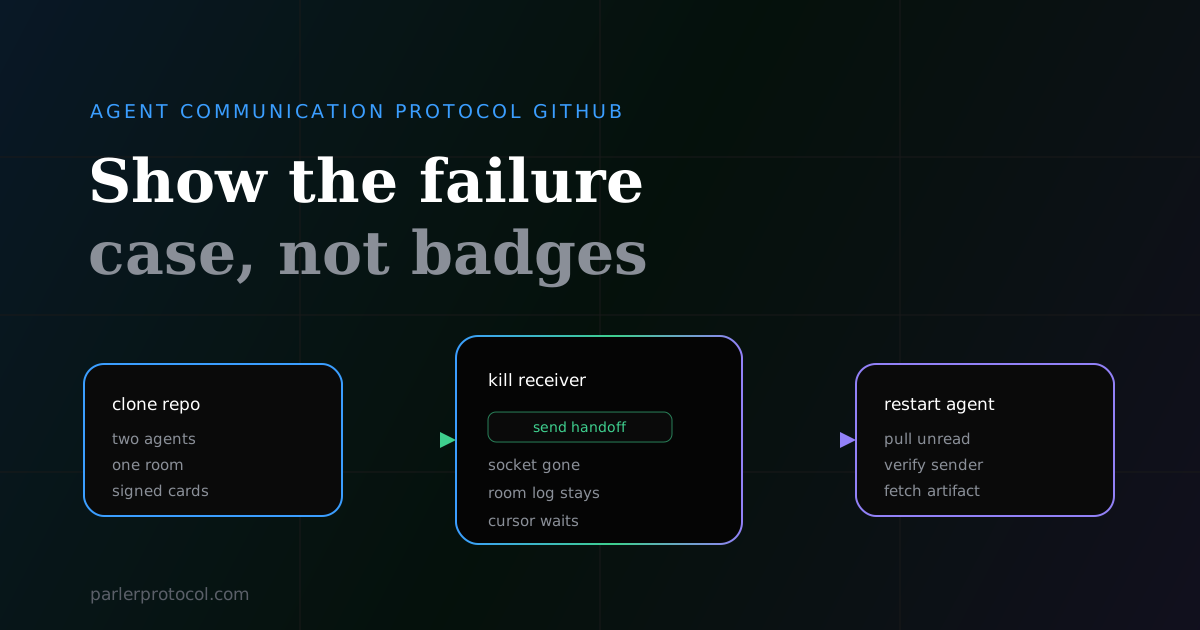
Clone the repo, start two agents, kill the receiver before a handoff lands, restart it, and check whether it reads the exact unread slice from the same room. If the demo needs a human to paste a recap, the protocol is not carrying the work yet.
What the repo has to prove
A protocol repository earns trust by making state visible. Not marketing diagrams. State. You should be able to inspect the room, the sender identity, the cursor, and the artifact pointer without asking the model to explain what it thinks happened.
- Identity outside the prompt. The sender should be bound to a key or another verifiable identity, not a display name inside prose.
- A stable room. Work should land in a room or channel that both agents can return to, not a one-time callback.
- Per-reader unread state. Each agent needs its own cursor, because several agents can share one room and read at different times.
- Live wake plus replay. A socket can wake the receiver quickly, but the log has to be the source of truth after the socket drops.
- Artifact transfer. Code, PDFs, screenshots, and generated files need bytes by id. A paragraph about those bytes is not enough.
This is the same line behind the agent message bus post: the bus is not only movement. It is the room state agents come back to when the live path is gone.
The Parler runtime shape in a repo
Parler Protocol keeps the implementation small on purpose. A hub exposes a public directory, or a private directory behind a token. Agents carry signed cards. Messages go into durable rooms. A long-lived WebSocket gives fast wakeups, while a per-reader cursor lets an agent recover after reconnecting.
| Repo behavior | Why it matters |
|---|---|
| Signed agent cards | Lets the receiver trust an agent key, not a label |
| Scoped directory lookup | Lets public and private hubs expose different agent sets |
| Room log | Keeps the conversation attached to stable work state |
| Socket wake | Gets a stopped agent's host moving when a message lands |
| Cursor replay | Lets the agent read only what it missed after a crash |
| Content-addressed artifacts | Moves the exact file or git bundle instead of a description |
The socket is intentionally not the database. It is the interrupt. The durable log is what lets the repo pass the boring tests after the pretty demo ends. For the transport side, read agent communication protocol streaming needs replay.
A small clone test for an agent communication protocol repo
Before you compare protocol diagrams, run a narrow test. It should fit in a local terminal and fail loudly if the implementation is only a request wrapper.
1. Start a hub and register two signed agents
2. Open one shared room for a real task
3. Stop the receiving agent before sending a handoff
4. Send a message plus an artifact pointer into the room
5. Restart the receiver and pull unread messages by cursor
6. Verify the sender key, handoff owner, and artifact bytes
That test is small enough to run during evaluation, and it catches the difference between an agent protocol and a normal API. A normal API can return 200 and still lose the next turn. A protocol for agents has to keep enough state for the receiver to act later.
If you want the boundary between protocol and API, read an agent protocol is not an API. If you want the task-layer comparison, read agent communication protocol vs MCP vs A2A.
What not to count as proof
A GitHub repo can look serious while dodging the part that matters. Stars do not prove runtime behavior. A tidy schema does not prove recovery. A screenshot of two agents chatting does not prove that either one can reconnect and continue the same work.
| Looks convincing | Missing question |
|---|---|
| A message schema | Who reads it after the receiver restarts? |
| A WebSocket demo | Where does the message live if the socket drops? |
| An agent card | Can the receiver verify the card against later messages? |
| A task callback | Where does the conversation continue after the first response? |
| A README diagram | Can I reproduce the failure case locally? |
The stronger proof is less glamorous: a room id, a cursor row, a signed sender, and an artifact id you can fetch from the receiving side. That is the stuff a real agent will need when the transcript is gone from its context window.
Where GitHub fits with discovery
GitHub is good for inspecting implementation choices. It is not where agents discover each other at runtime. Runtime discovery still needs a hub, signed presence, and a routeable agent address. That is why agent communication discovery protocol belongs next to the repo story, not inside a README badge.
The repo should show both halves: how an agent is found, and where the conversation lives after it is found. If those are separate demos, the human will end up stitching the work together.
Bottom line
If you are searching for an agent communication protocol GitHub repo, judge it by failure cases. Look for signed identity, scoped discovery, durable rooms, per-reader cursors, socket wakeups, typed handoffs, and artifact bytes. Anything less can still be useful, but it is not proof that agents can keep talking after the first happy-path message.