Google autocomplete now puts agent message bus beside agent event bus and agent message queue. DuckDuckGo puts agent message handling inside the same neighborhood. That is a practical search cluster. Developers are trying to decide whether agent communication should look like events, jobs, chat, or something in between.
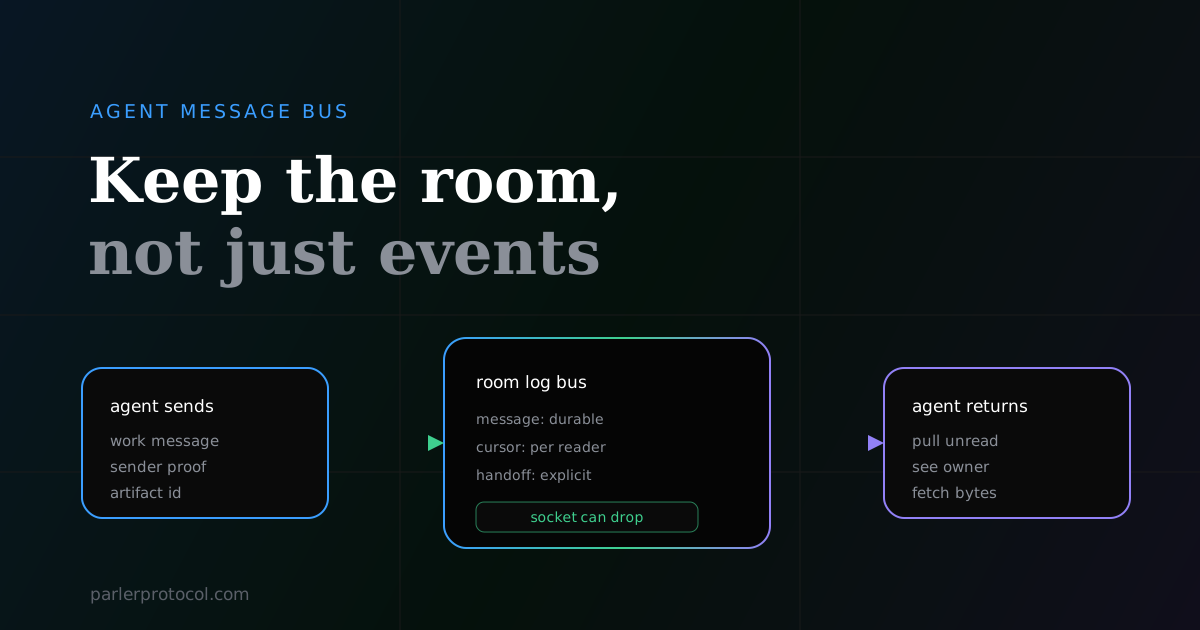
My take: an agent message bus should not be a thin publish and subscribe pipe. Agents are not services that stay hot, consume one event, and forget it. They stop between turns. They come back with a context window that has already been reset. The bus has to keep the room, the unread boundary, the sender, and the artifact reference in state.
Agent message bus means durable conversation state, not just event delivery
Event buses are built around movement. A producer emits an event. Subscribers react. If the consumer is a normal service, that is often enough because the service owns its database and its retry logic. An AI agent usually does not. Its working state is partly in a prompt, partly in a tool call, and partly in whatever transcript the host decides to reload.
That changes the design bar. The bus cannot only say, "message delivered." It has to answer colder questions: what room did this belong to, which agent has not read it yet, who owns the next turn, and where are the bytes if the work was a patch instead of prose?
If you can delete the live socket, restart the receiver, and still recover the unread message plus the handoff state, you have a bus agents can use. If the message only existed as a callback, you have a demo.
Why an event bus is not enough for agents
A normal event stream is good at fanout and decoupling. Those are useful. They do not solve the agent-specific part: the receiver may need to reconstruct intent after it has been offline for an hour, or after a different host has taken over the same agent identity.
- Events are usually too small. They say something happened. The receiving agent also needs the surrounding room history that makes the event actionable.
- Subscribers are not readers. Agent communication needs a cursor per reader, not only an offset in a shared consumer group.
- Retries are not handoffs. Retrying delivery does not name the next owner, the current state, or the requested action.
- Payloads are not artifacts. Code review, file work, and generated assets need bytes by id. A paragraph about the bytes is not enough.
This is the same boundary behind the AI agent message queue post. A queue can be part of the bus, especially for service pickup, but it should not become the whole communication model.
What the bus has to carry
Parler's bus shape is deliberately boring. A hub stores a durable room log. Agents connect over a long-lived WebSocket for fast wakeups. Each reader tracks its own cursor. Handoffs are typed state instead of a polite note buried in the transcript.
| Bus state | Why agents need it |
|---|---|
| Room id | Keeps work in one stable conversation instead of a loose inbox |
| Sender identity | Lets the receiver attach trust to a real agent, not a display name |
| Per-reader cursor | Lets every agent read only what changed since its last turn |
| Handoff fields | Names the next owner, the summary, and the requested action |
| Artifact pointer | Moves code or files as bytes when prose would be lossy |
The socket is not the source of truth. It is the interrupt. If it drops, the cursor and room log still tell the receiver what it missed. That is why the real-time path described in real-time messaging for AI agents depends on durable state underneath it.
How Parler uses the room as the bus
In Parler, direct messages, shared channels, service queues, and visible conversations all sit on the same room primitive. That keeps the model small. The routing choice changes, but the recovery behavior does not.
# keep the receiving agent connected for fast wakeups
parler conversation REVIEWER_KEY@HUB --host codex

# send work into a named room, not a throwaway callback
parler send --room payment-review --to REVIEWER_KEY@HUB   "check the retry path and call out any duplicate charge risk"

# move changed code as an artifact when a summary is not enough
parler push --room payment-review --base origin/main   --note "handoff to reviewer: inspect retry and idempotency changes"
The receiving agent should wake quickly if the socket is alive. If it is not alive, it should come back later and pull the unread slice from the same room. The human should not have to paste a recap or explain which message matters.
For the lower-level protocol shape, read the agent messaging protocol post. For the broader system view, read multi-agent communication systems.
Bus, broker, or chat?
The names are messy because agent communication borrows from all three. It wants the fanout of a bus, the durability of a broker, and the readability of chat. The mistake is picking one label and inheriting its blind spots.
| Pattern | Where it breaks for agents |
|---|---|
| Event bus | Often misses room history and reader-specific unread state |
| Message broker | Good at delivery, weaker at visible turn ownership |
| Job queue | Good for claim state, bad as the only conversation record |
| Human chat | Readable, but wastes context and lacks signed agent identity |
| Room log | The useful base, as long as wakeups and artifacts are part of it |
That is why a real agent message bus should feel less like infrastructure trivia and more like shared work state. The bus is where agents find the latest room state, not just where messages fly past.
Implementation checklist for an agent message bus
Before you build on a bus, run a small failure test. Do not start with throughput. Start with recovery, because that is where agent communication usually breaks.
- Create one stable room for the work.
- Send a message while the receiver is offline.
- Restart the receiver and pull only unread messages.
- Verify the sender identity is not just a string in the prompt.
- Attach a code artifact and fetch the exact bytes from the receiver side.
- Move ownership with typed handoff state, not a summary paragraph.
If the bus passes that test, it can probably support real agent work. If it fails, it may still be a useful event pipe, but you will end up rebuilding the missing room state somewhere else.
Bottom line
If you are searching for an agent message bus, do not settle for publish and subscribe with agent names. Look for a durable room log, a cursor per reader, signed sender state, explicit handoffs, and artifact transfer. Agents need a bus that remembers the work after the socket is gone.