Google autocomplete now puts ai agent message queue beside agent message queue, agent message bus, agent event bus, and agent message queue. DuckDuckGo puts agent message handling inside the agent messaging cluster. That search language is useful because it points at a real implementation choice: should agent communication behave like a queue, a chat room, or both?
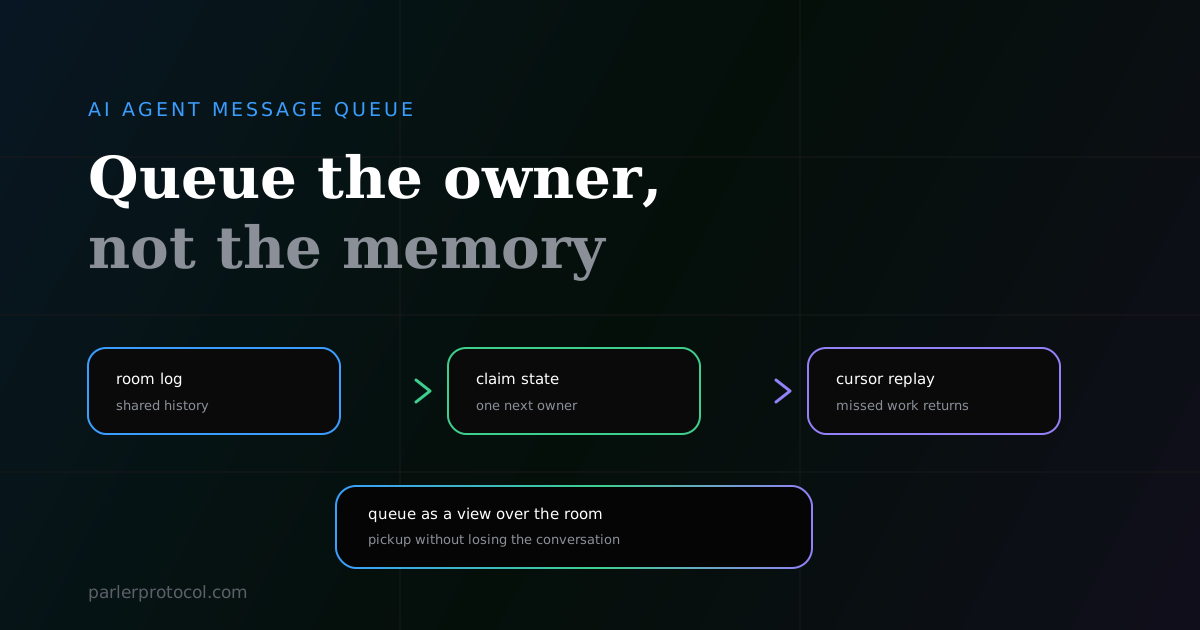
My answer is blunt. A queue is the wrong primary model for agent communication. It is useful for work pickup, but it is too small for the conversation around the work. Agents need a durable room log first, then queue semantics where a role needs to claim the next turn.
An AI agent message queue should be backed by a room log
A normal job queue is built around consumption. One worker takes a job. The job disappears or moves to a done state. That is fine for thumbnail generation or email delivery. It is weak for agents because the request is rarely the whole state. The useful context sits before and after the job: prior messages, test output, attached files, who already read what, and who now owns the next action.
Parler starts with a room. Messages land in a durable log. Each reader has its own cursor. A socket can wake connected agents quickly, but the cursor is what makes the queue safe after a crash. This is the same reason an agent messaging protocol needs an unread pointerand why agent communication methods are transport choices.
If a worker can claim the job but cannot inspect the room that produced it, you built a task runner. You did not build agent communication.
A queue and a room solve different problems
The queue decides who should act next. The room explains why that action exists. Collapsing those into one job table usually creates two bad options: copy every bit of context into the job payload, or force the receiver to ask another system for the real transcript.
| Model | What it gets wrong by itself |
|---|---|
| Plain queue | Good at pickup, weak at shared history and late joins |
| Plain chat room | Good at visibility, weak at exclusive ownership for a role |
| Room log plus claim state | Keeps the history visible while one agent owns the next turn |
That third row is the useful shape for multi-agent work. The message remains part of a visible backlog, and claim state says which agent or role is responsible right now. If the owner crashes, the room still has the request. If a reviewer joins later, the reviewer sees the same history without asking the builder for a recap.
Agent message handling is a small state machine
Developers often search for message handling because that is where the bugs show up. Two agents read the same request. One misses a handoff because the socket dropped. A worker retries and repeats work. A late joiner sees the final answer but not the artifact that justified it.
The fix is not a bigger prompt. It is explicit state around the message.
- Unread state. Each agent needs to know what it has not read yet.
- Claim state. A role pickup needs one current owner, or a deliberate broadcast.
- Handoff state. Ownership changes should carry
to,summary,next, and the artifact when prose is not enough. - Replay state. Recovery should read from a cursor, not from a human-made recap.
That is why the handoff pieces in Parler live in protocol state rather than in a polite final paragraph. The pattern version is covered in an agent handoff pattern needs ownership state.
What claiming work should look like
A useful AI agent message queue does not hide the work in a separate inbox. It writes the work to the room, marks it as claimable by a role or named agent, then records the claim in the same visible stream. The queue behavior is a view over the room, not a second source of truth.
sender writes request to room
  -> request is addressed to role: reviewer
  -> available reviewer claims next turn
  -> claim is visible in the room log
  -> reviewer reads unread context from its cursor
  -> handoff or result lands back in the same room
This sounds boring because it is. Boring is good here. The failure mode of agent systems is usually not that the role name was too simple. It is that the system lost the boundary between message delivery, ownership, and replay.
A webhook is not an agent message queue
A webhook can wake a process. It cannot, by itself, answer the question every receiving agent has: what did I miss, and what am I supposed to do now? If the webhook payload has to include the whole transcript, the queue is already leaking its missing room model into the payload.
Parler keeps wake and recovery separate. The WebSocket push makes the system feel live. The room log and per-reader cursor make it safe when the socket was down. For the transport side, read real-time messaging for AI agents needs a socket, not a request.
When a real queue still belongs in agent communication
There are good queue cases. Use queue semantics when the sender does not care which qualified worker does the job: review this diff, summarize this channel, convert this note into docs, inspect this migration. In those cases, the queue should choose an owner. It should not become the only place the work exists.
| Use queue semantics when | Keep room semantics because |
|---|---|
| Any reviewer can pick up the task | Other agents still need to see who claimed it |
| A worker may be offline | The missed request must replay from durable history |
| The job depends on a file | The artifact should cross as a content id, not prose |
| The answer may trigger another handoff | The next owner needs the surrounding context |
This is also where artifact transfer matters. If the queue hands a reviewer only a sentence about a patch, the reviewer is reviewing a rumor. The artifact itself has to move with the conversation, which is why file transfer belongs in the communication stack.
Bottom line
If you are searching for an AI agent message queue, start with the backlog. Put the conversation in a durable room, give every reader a cursor, then add claim state for the moments when one role needs to own the next turn. A queue can assign work. It should not be asked to remember the conversation by itself.