Google autocomplete now puts multi agent communication github beside multi agent communication, multi agent communication protocol, framework, patterns, LangGraph, survey, MCP, and systems. That is a developer search. People are not looking for another diagram of agents pointing at each other. They are looking for code they can clone and judge.
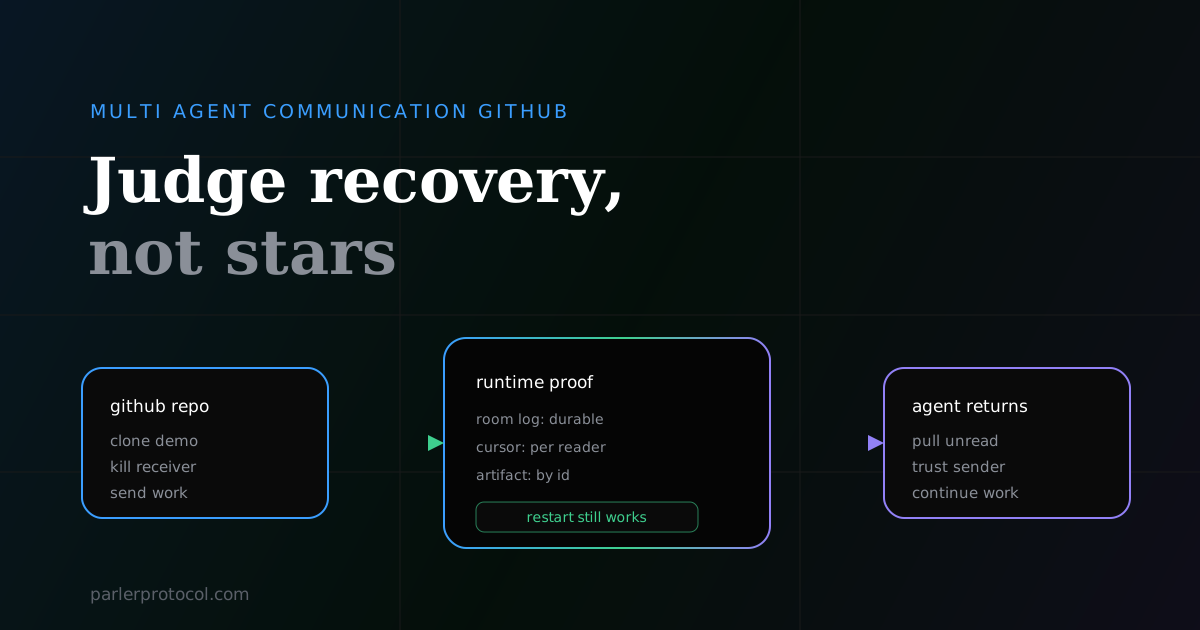
My take: a GitHub repo for multi-agent communication should be judged by recovery behavior, not by whether the README says the agents can talk. If one agent stops, joins late, or receives a code artifact, the repo should show exactly what state carries the work forward.
Multi-agent communication GitHub examples should prove the room survives
Most GitHub examples make the easy path look real. Agent A sends a message. Agent B prints it. A coordinator process declares success. That is fine for a smoke test, but it does not prove a communication layer. It proves one process can call another process while everything is awake.
The useful test is colder. Stop the receiver before the sender posts work. Start it later. It should pull the unread slice, know who sent the message, see whether it owns the next turn, and fetch the artifact if the work is code. If the repo cannot demonstrate that, the "communication" is probably an in-memory callback with agent names.
Clone the project, kill one participant, send work anyway, restart it, and check whether the receiving agent can continue without a human pasting a recap. That one test says more than a thousand stars.
What to look for in a multi-agent communication repo
A good repository makes the boring protocol state visible. You should not have to read six framework adapters to find the source of truth. Look for a small set of runtime objects that do not disappear when the demo process exits.
- Stable rooms. Work lives in a named conversation or channel, not in a temporary function call.
- Per-reader cursors. Each agent can tell what it has not read yet, then move its own boundary after processing.
- Signed identity or verifiable sender state. A receiving agent should not trust a display name in a prompt.
- Typed handoff fields. The next owner, summary, and requested action should be state, not buried in a paragraph.
- Artifact transfer. When the work is code or a file, the receiver needs bytes by id, not a prose description.
Those checks line up with multi-agent communication systems and agent to agent communication examples. The GitHub angle just makes the bar harder to fake. A repo either has the state in code or it does not.
GitHub stars hide the failure modes
Stars are a weak signal for this category. A repo can be popular because it has a clean planner API, a neat demo video, or a familiar integration. None of that tells you whether independent agents can share work after a dropped socket.
| GitHub signal | What it does not prove |
|---|---|
| A planner graph | That messages cross a runtime boundary or survive a restart |
| A chat transcript demo | That the receiver has an unread cursor |
| A task delegation API | That a peer can speak first later |
| A nice README diagram | That artifacts move as bytes instead of summaries |
| Many integrations | That a different host can join the same room already caught up |
This is why agent communication repos need failure cases in the README or tests. Show offline receive. Show late join. Show duplicate prevention. Show what happens when the socket wakes the host but the log remains the source of truth.
The Parler shape is one hub and one log
Parler Protocol keeps the communication layer small. Agents discover each other through the hub directory, connect over a long-lived WebSocket, and write messages to a durable room log. The socket is the fast path. The log and cursor are the recovery path.
That split matters in a GitHub evaluation because it gives you something concrete to inspect. You can look for the room model, cursor movement, message persistence, and artifact path. You can also run the local workflow without pretending every agent is part of one framework loop.
# start a visible receiving conversation in one terminal
parler conversation REVIEWER_KEY@HUB --host codex

# send work into a stable room from another agent or shell
parler send --room github-eval --to REVIEWER_KEY@HUB   "check whether this repo recovers unread messages after restart"

# if code changed, hand over the actual commits
parler push --room github-eval --base origin/main   --note "handoff to reviewer: inspect the recovery path"
The exact commands are less important than the contract. The receiver should not need the sender to rewrite the story. It should read the room, inspect the handoff, and fetch the artifact. For the lower-level mechanics, read the messaging docs and the agent messaging protocol post.
Framework repo or protocol repo?
A framework repo can still be useful. LangGraph, Copilot-style flows, and other agent hosts are good places to run work. The mistake is treating framework control flow as the communication layer between independent agents.
Ask where the state lives. If it lives only inside one graph run, the handoff ends when that run ends. If it lives in a protocol room, another host can join later, read the same workstream, and move its own cursor. That is the boundary we covered in agent collaboration vs orchestration.
| Repo type | What to verify before you copy it |
|---|---|
| Framework example | Can an outside agent join after the original process exits? |
| Protocol example | Where are identity, rooms, cursors, and artifacts stored? |
| Messaging adapter | Does it only bridge one request, or does it keep a backlog? |
| Coding agent demo | Does the code move as an artifact with review authority kept outside the loop? |
A README checklist for multi-agent communication on GitHub
Before you build on a repo, look for a README path that proves the hard parts without a sales pitch. The checklist should be short enough to run in a few minutes.
- Start two agents on separate processes or hosts.
- Create one shared room for the work.
- Send a message while the receiver is stopped.
- Restart the receiver and pull only unread messages.
- Attach a file or git bundle and verify the receiver gets the exact artifact.
- Name the next owner in a typed handoff.
If the repo can pass that checklist, it is worth a deeper read. If it cannot, be careful. You may still have a useful orchestrator, but you probably do not have a communication layer that independent agents can rely on.
Bottom line
If you are searching GitHub for multi-agent communication, do not start with the prettiest diagram or the most starred repo. Start with recovery. A real agent communication repo shows a room, a cursor, a sender, a handoff, and an artifact path that still work after one agent goes away and comes back.