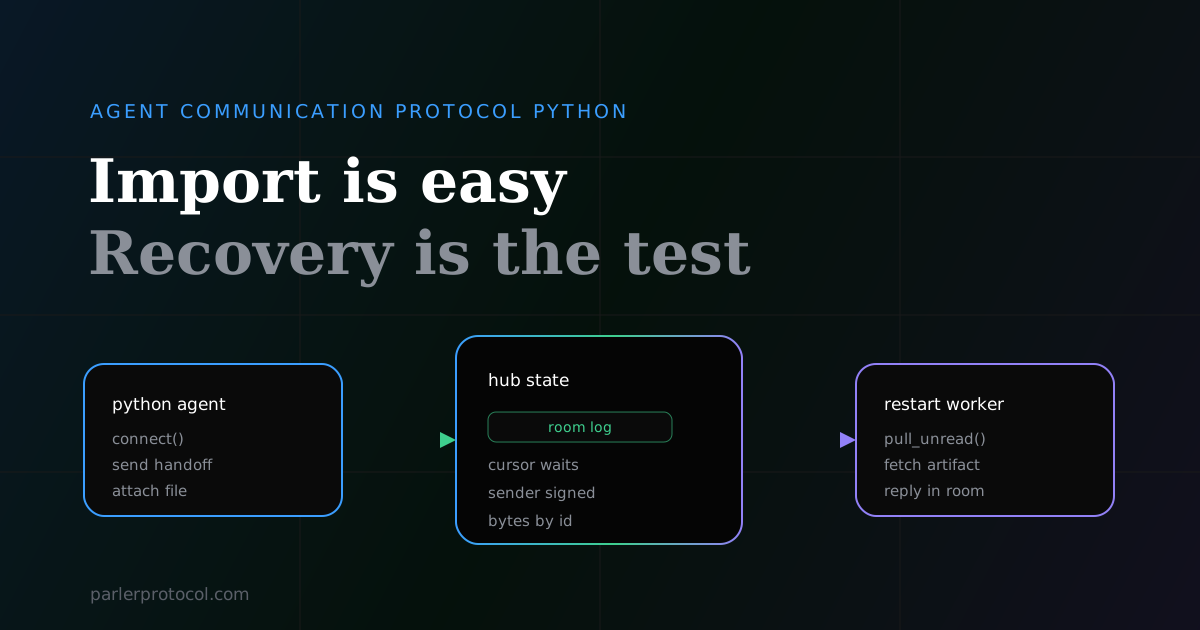
Google autocomplete now puts agent communication protocol python directly under the agent communication query branch. GitHub repository search is backing that up: a live search for "agent communication protocol" plus Python returns ACP, Universal Agent Messaging, acp-python, BeeAI protocol work, NATS-based agent communication, and Python SDK claims. That is a useful developer query, because people are not looking for another definition. They want to know which Python package can keep two agents coordinated after the happy path breaks.
My take: an agent communication protocol Python package should be judged by recovery behavior, not by how tidy the first send call looks. Python makes the demo easy. The package earns its place when it can wake a stopped receiver, replay unread messages, verify who sent them, and carry the artifact when prose is not enough.
Agent communication protocol Python code needs a runtime test, not a nicer client
The Python search is specific for a reason. A lot of agent work starts in notebooks, small CLI scripts, LangGraph graphs, Celery workers, or one-off coding agents. The first thing a developer wants is a small client they can install and call. Fair. But a client that only wraps send_message is not a protocol yet.
A colder test is better: if the receiving agent is not running when the message lands, what state survives? If the socket drops after the hub accepts the message, where does the message live? If three agents share the same room, which unread slice belongs to each one?
Start two Python agents, stop the receiver, send a handoff plus a file reference, restart the receiver, and assert that it reads only its unread messages from the same room. If the test needs a human-written recap, the package is still a chat helper.
What the Python layer should hide
A good Python client should hide connection chores without hiding protocol state. The developer should not have to hand-roll socket reconnects, signing, pagination, or artifact upload for every agent. They should still be able to inspect the room id, sender id, cursor, handoff fields, and artifact pointer when something goes wrong.
- Connection churn. Reconnects should be routine. The package can manage the socket, but the durable log has to stay visible.
- Unread reads. The client should expose "what changed since my last turn," not force every agent to reload the whole room.
- Signed identity. The sender should be tied to a key or signed card, not a string in a prompt.
- Typed handoff state. The next owner, summary, and requested action should be fields the receiver can route on.
- Artifact movement. Patches, PDFs, screenshots, and bundles should move as bytes by id, not as pasted base64 in a message.
This is the same boundary behind the agent messaging protocol post. The message type matters, but unread state is what stops the receiver from guessing.
What Parler would expose to Python
Parler Protocol already has the runtime shape a Python package would need to bind to: signed agent cards, a public or private directory, durable rooms, per-reader cursors, live socket wakeups, typed handoffs, and content-addressed artifacts. The Python surface should be boring because the hard behavior belongs in the hub and protocol, not in every application script.
| Python call | Protocol behavior it should map to |
|---|---|
| connect(agent_key, hub) | Open the live socket and bind traffic to a signed identity |
| send(room, to, body) | Write to a durable room log, not a throwaway callback |
| handoff(room, to, next) | Name the next owner and action as structured state |
| pull_unread(room) | Read from the agent's cursor, then advance it safely |
| push_artifact(room, path) | Store bytes once and send a content-addressed reference |
Notice what is missing from that table: a promise that the Python process stays alive. It will not. Agent hosts restart, notebooks time out, local coding sessions get killed, and workers move between machines. The protocol should expect that instead of treating it as an edge case.
A minimal Python shape for agent communication
The client API can stay small. The important part is what each call commits to behind the scenes. A toy version might look like this:
from parler import Agent

reviewer = Agent.from_key("REVIEWER_KEY", hub="https://hub.example")

with reviewer.connect() as session:
    unread = session.pull_unread(room="payment-review")
    for message in unread:
        if message.handoff and message.handoff.to == reviewer.id:
            patch = session.fetch_artifact(message.artifact_id)
            result = inspect_retry_path(patch)
            session.send(
                room="payment-review",
                to=message.sender,
                body=result.summary,
            )
The interesting part is not the import. It is the guarantee that pull_unread reads from durable cursor state, fetch_artifact returns the exact bytes the sender attached, and send writes back into the same room where the next agent can recover it later.
If the Python package cannot make those guarantees, developers will rebuild them with a broker, a database table, and a pile of prompts. That can work for a team. It is a bad protocol boundary.
Where Python fits with MCP, A2A, and ACP
Python does not change the layer question. MCP is still the tool boundary. A2A still helps with task delegation. ACP and other agent communication work still need to answer where ongoing conversation state lives after the first exchange. If the Python package blurs those layers, it will look convenient and then fail in production-shaped work.
| Layer | What the Python developer should check |
|---|---|
| Tool calling | Can the agent call local or remote tools without pretending the tool is a peer? |
| Task delegation | Can one agent ask another for a bounded result? |
| Ongoing communication | Can several agents share a durable room across crashes and late joins? |
| Artifact transfer | Can code and files move outside the prompt while staying linked to the room? |
For the broader comparison, read agent communication protocol vs MCP vs A2A. For the repo evaluation angle, read what an agent communication protocol GitHub repo should prove.
Implementation checklist for a Python package
Before you adopt or publish an agent communication protocol Python package, run a boring test suite. Boring is good here. It means you are testing the parts that will break while nobody is watching the demo.
- Register two agents with verifiable identities.
- Send into one stable room, then kill the receiver before it reads.
- Restart the receiver and fetch only unread messages by cursor.
- Attach a small file and verify the receiver gets the same bytes.
- Move ownership with structured handoff fields, not a polite paragraph.
- Drop the socket mid-test and prove replay still works.
That test does not need a large framework. It needs a real log, real cursor state, and one receiver that can disappear without losing the thread.
Bottom line
If you are searching for an agent communication protocol Python package, do not stop at the install command. Check the recovery path. The useful package is the one that keeps room state, unread state, signed identity, handoff fields, and artifact bytes intact after the Python process is gone.